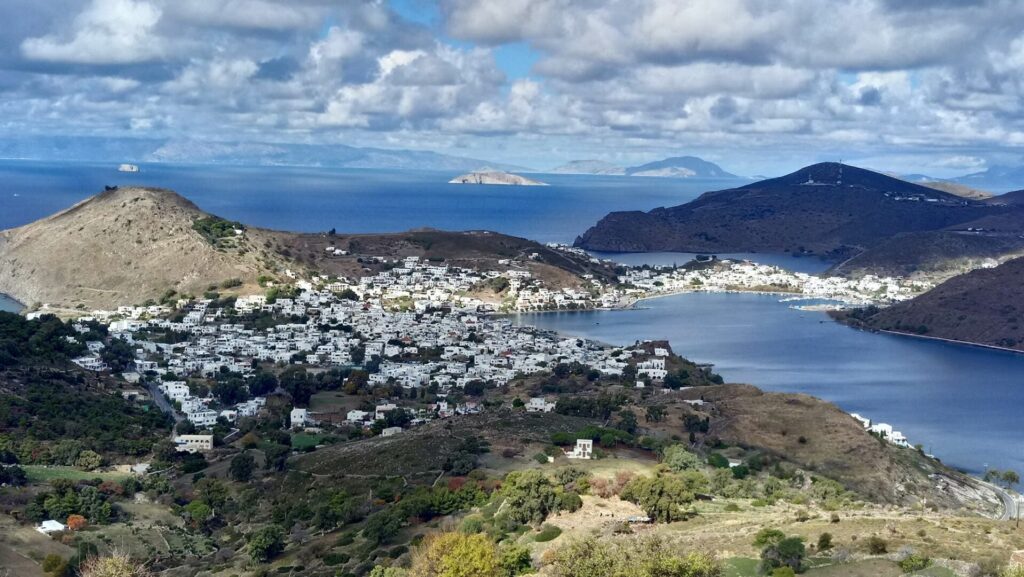
THE GENESIS HISTORICALLY The subsidence of the African plate under the minor plate of the Aegean generated many volcanoes. Modulating an arc at the South part of the Aegean where Patmos occurs to be today.Patmos (Latmos in antiquity) was the beloved island of Selene, the goddess of the moon. During the prehistoric years, it was first inhabitant by the Carians and the Dorians who were succeeded by the Ionians then colonized it. The name Patmos is believed to stem from a mountain called Latmos from Karia in Asia Minor. It is also said that Orestis pursued by the Furies, for murdering his mother Klytemnestra, took refuge on Patmos as he was traveling with the Argeious.walls that are at the area of Castelli are dated from the 6th to the 4th century BC and the different ruins reveal the existence of an acropolis, which is considered the place where the temples of the gods Apollo and Dionysus once stood and a hippodrome. According to the archeological finds mostly on walls of churches, shows that the social and the cultural life of Patmos were blossoming during the ancient times.The patron goddess of the island is considered the Patmian Artemis, a figure of Ephesus. Her temple was in Chora and on the same site; the great basilica of St. John was built over its ruins at the beginning, later on, St. Christodoulos built the Monastery to honor St. John the Theologian.ΙΣΤΟΡΙΚΑ Η Γέννηση Η καθίζηση της Αφρικανικής Πλάκας κάτω από τη μικροπλάκα του Αιγαίου, δημιούργησε πολλά ηφαίστεια, διαμορφώνοντας ένα τόξο στο Νότιο Αιγαίο πάνω στο οποίο βρίσκεται και η Πάτμος. Η Πάτμος (Λάτμος κατά την αρχαιότητα) ήταν το αγαπημένο νησί της θεάς του φεγγαριού Σελήνης! Προϊστορικά κατοικήθηκε από τους Καριείς! Αργότερα αποικήθηκε από τους Δωριείς και μετέπειτα από τους Ίωνες! Το όνομα Πάτμος πιστεύετε ότι προήλθε από το όνομα του βουνού στη Καριά της Μικράς Ασίας Λάτμος. Λέγεται μάλιστα ότι ο Ορέστης, κυνηγημένος από τις Ερινύες επειδή σκότωσε την μητέρα του την Κλυταιμνήστρα, περνώντας με τους Αργείους βρήκε καταφύγιο στην Πάτμο.Τα τείχη που υπάρχουν στην περιοχή Καστέλι χρονολογούνται από τον 6ο και 4ο π.χ. αιώνα και τα διάφορα ευρήματα, φανερώνουν την ύπαρξη ακρόπολης, στην οποία πιστεύετε ότι υπήρχαν ναοί των Θεών Απόλλωνα και Διόνυσου καθώς και ιππόδρομος! Σύμφωνα δε με τα ευρήματα, κυρίως σε τοίχους εκκλησιών, η κοινωνική και πολιτιστική ζωή της Πάτμου ανθούσε κατά την αρχαιότητα. Πολιούχος θεά του νησιού θεωρείτο, η Πατμία ?ρτεμις, μορφή της Εφέσου και ο ναός της βρισκόταν στη Χώρα, στα ερείπια του οποίου χτίστηκε στην αρχή η μεγάλη βασιλική του αγίου Ιωάννη του Θεολόγου από τον ίδιο και μετέπειτα η Μονή από τον Όσιο Χριστόδουλο.THE COURSEDECLINE AND PROSPERITYPatmos fell into decline when the Romans occupied the island. Most of the inhabitants abandoned the island and the Romans transformed Patmos into a place of exile. John, the beloved disciple of Christ, was exiled to Patmos from the emperor Domitian in 95 AD. Thus, the Christian era of Patmos began. However, from then until the 11th century the island`s history is lost in total darknessThe arrival of St. Christodoulos and the founding of the Monastery of St. John the Theologian as well changed the facts and contributed to the culture, which thrived afterwards. St. Christodoulos eagerness for learning, established the first library of the Monastery and settlements were developed at the north part of the island. Permission was given to the Patmians to build their houses near the Monastery to protect themselves from the pirate invasions that deplored the Aegean. The first houses were built at the south part and they were one storied at the beginning and later on, enviable houses were built with basements too. The fall of Constantinople from the Turks in 1453 brought a different but special atmosphere to Patmos and the settlement of Allotina to the west of the Monastery in