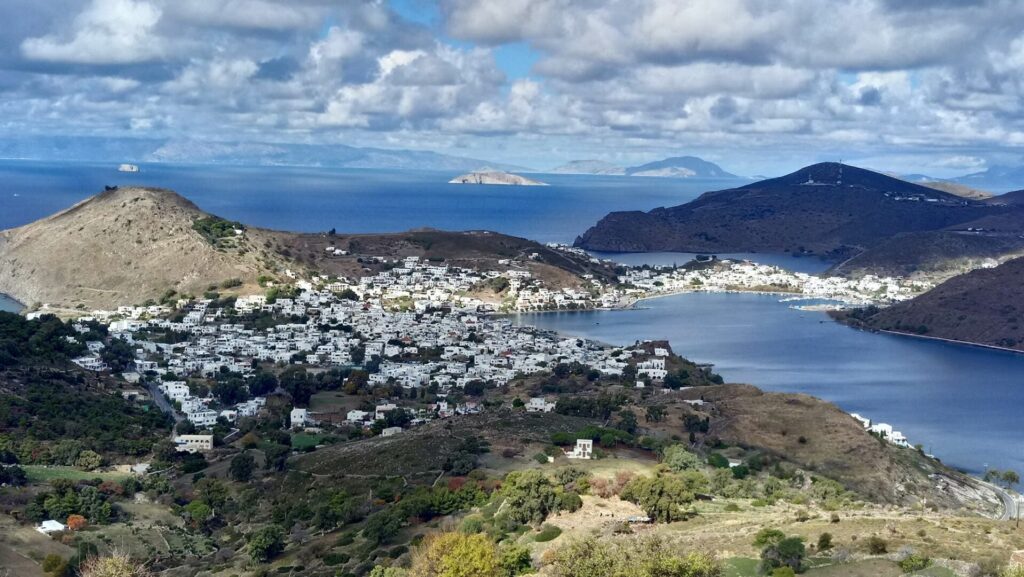
THE MONASTERYThe construction of The Monastery of St. John the Theologian started in 1088, when the Byzantine emperor Alexios Comnenus the First gave the whole island to St. Christodoulos the Latrinos by a Deed of Grant bearing the Golden Seal. He was named Latrinos since, before he came to Patmos, he was living at the Mount Latros. Because of the Turks, he asked the emperor to give to him the small deserted and arid island to settle on. Many monks and other people as well, were coming from Crete and Minor Asia, to settle on the island, accompanying St. Christodoulos. The latter, according to the term in Alexios Comnenus`s Grant, were obliged to be without their wives and children. As soon as the Monastery and the fortress were completed, the necessity of cultivating the island became evident. Knowing the fact that it was impossible to retain permanent residents without families, St. Christodoulos decided to allow the settlement of families. He also called on all the craftsmen to live far from the Monastery, on the north part of the island, where the monks were not allowed to go. The borders of the craftsmen`s settlement started from Ayios Nicholas the Eudelos to the area of Vagia. They were working and staying in the Monastery five days a week and the rest of the days they would go to their families. Even this solution was quite difficult, so in the 12th century AD the abbot of the Monastery at that time imposes on the villagers and on the soldiers, to live inside the Monastery during summer time, in order to protect it from the pirate invasions, which started that period. Thus, the 13th century the villagers requested to settle around the area of the Monastery, to refuge inside it and to defend it, in case of danger. Its great, impressive walls with a height of 15 meters, stands like a fortress and overlooks the island. Above the two and only entrances was installed the so-called killer, a sort of balcony, from which they threw burning oil, so as to block the pirates access. The Monastery belongs to the Ecumenical Patriarchate; it is a Patriarchic exarchate, with the abbot as a Patriarchic exarch, (nuncio) which has special privileges. THE ARCHITECTUREThe Monastery was built on five levels and its original form was meant to be a boat with its prow towards the Ikarion Sea but it was altered because of the many different necessities that occurred, for additions and modulations. The cells of the monks were built around the catholicon, the main church, according to the Byzantine architecture.As for the rest, the building is constructed on different levels and presents many elements from the traditional architecture of the islands. The final shape, it presents today, is the result not only of the needs that appeared through the years for adding and transforming the space, but also of the particularity of the rocky ground. The Monastery has ten chapels, from which the four are in the courtyard. In the main church of the Monastery, there is an icon screen of particular artistry. A work of art made by 12 sculptures in 1820. The icons and the wall paintings of the main church are of incomparable beauty and worth.b THE SACRISTY – THE MUSEUM AND THE LIBRARY The sacristy began from St. Christodoulos. In the entrance, there is a replica of the icon of the Apocalypse of 1626. There are also icons of great value, especially the mosaic icon of St. Nicholas from the 11th century. The vestments and ecclesiastical garments, made with golden thread, were gifts from wealthy Patmians. Silver and golden vessels, unique masterpieces, among those the mitre of the Patriarch Neophytos the 6th decorated with precious stones and gold.Another important part (chapter) of the Monastery is the library. The library is the written story of both, the Monastery and the whole island. Among the documents, you will encounter the Deed of Grant, Chrysobull, else known, of Alexios Comnenus,